Powering up the Midwest

By: Brittney Kenaston
Originally posted in In Business Madison.
The world is closer than ever to limitless clean energy thanks to recent advancements in nuclear fusion — and Wisconsin companies Realta Fusion and SHINE Technologies are at the forefront, positioning the state and region for explosive economic growth.
“I like to say, ‘Let’s knock the rust off the Rust Belt,’” said Kieran Furlong, founder and CEO of Madison-based Realta, one of dozens of global fusion companies reported by the Fusion Industry Association this year — and one of three spun out of the University of Wisconsin-Madison.
The process of nuclear fusion involves combining atomic nuclei to release energy. Since all matter is composed of atoms, this has the potential to transform how the world is powered, providing an inexhaustible, carbon-free energy supply.
Though the word “nuclear” can cause concern for some, advocates of the technology contend nuclear fusion provides safe, renewable energy without releasing long-lived, highly radioactive waste.
“We have to demystify the word nuclear, or ‘de-scare-ify’ it,” said Greg Piefer, SHINE’s founder and CEO. “Nuclear is not a bad word. It’s a really good word. Fusion is where all the earth’s energy comes from, and when we unlock it it will start an era of massive energy abundance.”
Proverbially, putting fusion energy on the grid has remained “20 years away” for quite some time, but that’s changing now with industry progress on the technological and business sides.
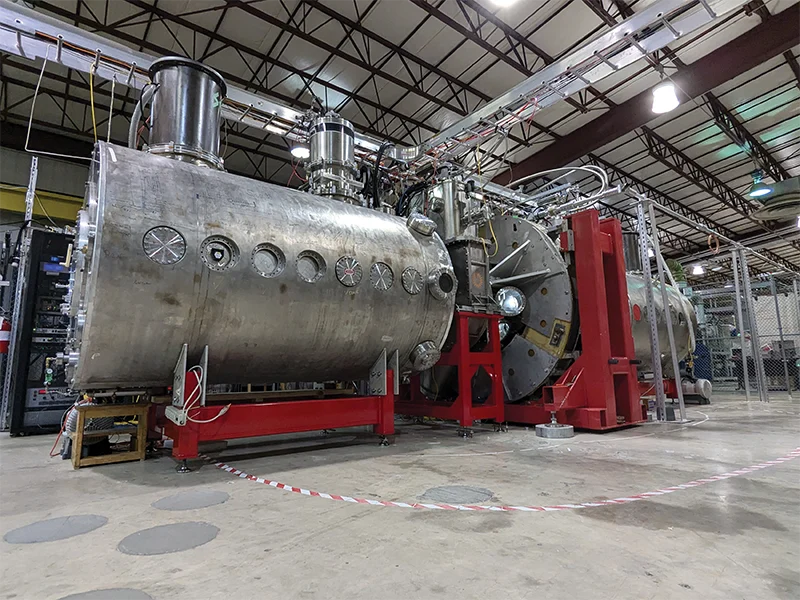
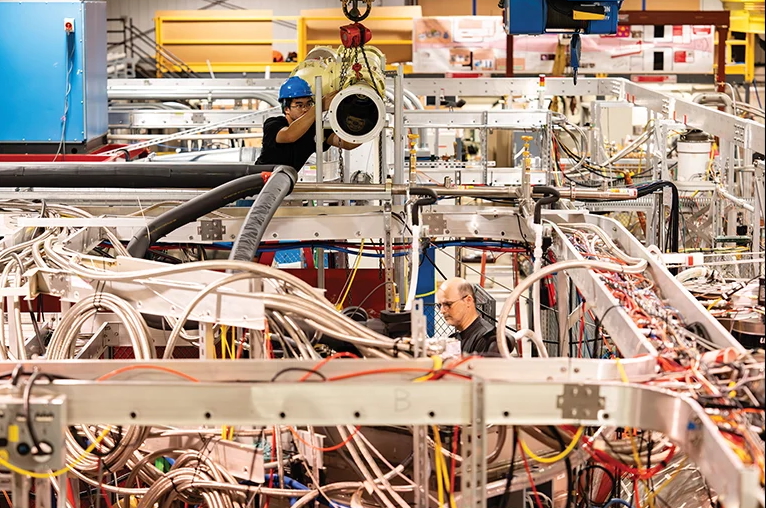
In fact, Realta is on track to reach commercially viable fusion energy as soon as 2035, working in partnership with the university on a leading-edge project called WHAM.
Janesville-based SHINE, also spun out of UW-Madison, is exploring commercial applications of fusion technology in areas like neutron testing and medical isotope production, capitalizing on the uses of byproducts of fusion reactions.
Ten years ago, “there was no landscape in fusion,” Piefer said. “We would talk about fusion, and literally nobody knew what we were talking about from an investment standpoint. … But I think it’s changed quite a bit.”
In the last five years alone, according to the FIA, the fusion industry has grown from 23 companies worldwide to around 50, headquartered across more than a dozen countries in North America, Europe, Asia and Oceania; employing more than 4,600 workers and supporting roughly 9,300 supply chain jobs.
“It’s a signal of maturing investor confidence, technological progress and a rapidly coalescing supply chain,” said FIA CEO Andrew Holland in an introduction to the group’s 2025 report. “The results of this year’s survey confirm the industry remains focused on the 2030s as the decade for commercialization.”
As industry growth accelerates, experts maintain it is more critical than ever for Wisconsin to prepare for a fusion-powered future.
That means continuing to fund research to drive innovation, spur more fusion companies and attract private investment; recruiting top global talent and developing the statewide workforce, especially in the manufacturing sphere; and building a fusion ecosystem with statewide and regional collaboration.
It’s a tricky call to answer because all of these steps must occur in coordination, and failure means missing out on enormous economic opportunities, advocates say.
For example, Type One Energy, a third UW-Madison spinout founded in 2019, retains a Madison office but last year opted to move its headquarters to Knoxville, Tennessee, after becoming the first recipient of funding through the state’s $50 million Nuclear Energy Fund.
“How do we create that conducive environment (for fusion)?” asked Realta’s Furlong. “People should start seeing Wisconsin as the home of fusion energy.”
“You’ve got to have the foothold,” said Kathleen Gallagher, executive director of the 5 Lakes Institute, a collaborative network that in May launched the Great Lakes Fusion Energy Alliance, bringing together companies and researchers to propel the region’s fusion energy economy. “I am completely convinced that there is a foothold in fusion, or (UW-Madison) wouldn’t have three spinouts. You need to build around that.
“Now is the time to lay the groundwork for a fusion industry in the Great Lakes.”
There is still a significant technological knot to unravel to make fusion energy commercially viable. And while it’s unknown who will succeed first — and when or how— local companies and experts agree that Wisconsin must lay the foundations today or be left behind.
Investment fuels industry
Realta’s Furlong cited “two parallel accelerations” driving momentum in the nuclear fusion space. The first stems from a key scientific breakthrough.
“If we could point to a single event, and as you know, scientific progress is never a single event … in December 2022, the U.S. Department of Energy announced that the Lawrence Livermore Lab (in California) had successfully done the first-ever controlled fusion reaction where more energy came out of the reaction site than went into it,” he said.
While there is still a long way to go to make the technology cost-effective and efficient to be deployed at a large scale, Furlong noted, “that was a major step.”
The other accelerant has been a massive recent influx of venture capital dollars to the nuclear fusion industry.
“It’s a symbiotic relationship,” Furlong said. “The technology is right, there’s people willing to take these ideas and say, ‘Yeah, we’re going to build a company,’ and then there’s investors willing to back those ideas. … Private capital, venture capital investors have shown up in a big, strong way to back novel fusion concepts being driven forward
by private companies.”
The FIA report confirms this notion. While the fusion industry by 2021 had attracted $1.9 billion in total investment, today that figure has surpassed $9.7 billion — over $2.6 billion of which
was raised in the last year alone.
UW-Madison professor Cary Forest, a Realta co-founder and the company’s chief scientific officer, added that the level of investment in nuclear fusion is likely to be the most influential factor
on how fast it gets to the grid.
“It’s more, ‘How much money does it take to get to fusion?’ rather than how long it takes to get to fusion,” he said.
In the meantime, the work that will drive the industry forward — fueling the birth of more fusion companies, more investment and the ultimate goal of global fusion power — begins in the lab.
At a Sept. 18 hearing before the House Committee on Science, Space, and Technology’s Energy Subcommittee in Washington, D.C., UW-Madison Assistant Professor Stephanie Diem testified about the critical need for sustained federal funding for fusion research.
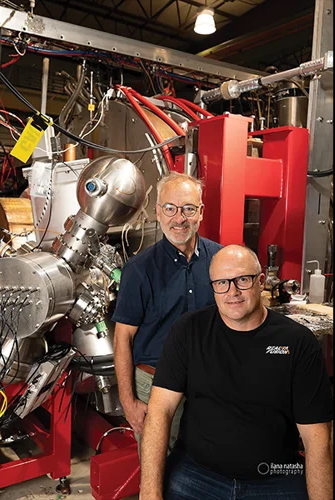
Diem is the principal investigator of UW-Madison’s Pegasus-III Experiment, which looks at innovations in startup techniques to reduce the cost and complexity of future fusion power plants.
“History has shown us that when the U.S. invests boldly in research, it not only secures global leadership but also delivers transformative benefits to society,” she testified. “We cannot afford to fall behind.”
Diem said continuing federal investment in university research is essential to catalyze innovation.
She noted that public-private partnerships will propel the industry toward commercialization, and urged expanded opportunities for education and training, and supply chain enhancement, to bolster fusion workforce development.
“We need to grow a robust fusion ecosystem,” she testified. “To move swiftly from proving fusion science to developing commercial fusion energy, we need larger regional hubs supported by federal and state funds that coordinate efforts and maximize efficiencies.”
From idea to Realta
Since its birth in 2022, Realta Fusion has leveraged public-private collaboration to strengthen its business and technologies, bringing it closer to cracking the nut of commercially viable fusion energy.
“We have a fusion energy system which is going to have a low-cost of electricity … and is scalable and modular,” CSO Forest said. “And it’s clean. It’s carbon-free.
“The company’s going to take it further than we could ever take it at the university.”
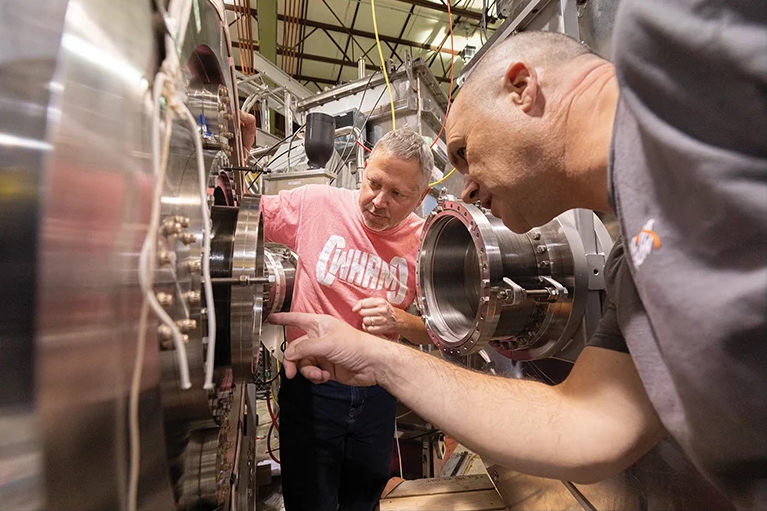
Realta was founded by Furlong, Forest, two other UW-Madison professors — Ben Lindley and Oliver Schmitz — and senior scientist Jay Anderson, and the company works side-by-side on the WHAM experiment with UW, which has an over half-century legacy in the field.
“The University of Wisconsin is one of the world’s leading research institutions when it comes to the scientific disciplines which underpin fusion energy,” said Furlong. “Plasma physics, nuclear engineering or engineering physics … the university has been one of the leaders in that for decades.”
He added that UW “currently has five operating fusion experiments. There are probably not many research institutions around the world that can match that. So that’s one of the big reasons why you’ve got such a prevalence … of fusion activity in the state of Wisconsin.”
Realta’s approach to fusion is a concept known as a magnetic mirror, a type of magnetic confinement.
Magnetic confinement — in the simplest terms — creates plasma and uses strong magnetic fields to contain and heat it until nuclei fuse and energy is released.
“The magnetic mirror was once the leading concept of U.S.-based fusion research, but when funding was dramatically cut in the 1980s, it was essentially put on the shelf,” Furlong said. “Work continued overseas, and in the middle of the last decade, two of my co-founders … began to see what was going on … and they were also beginning to learn about latest-generation superconductors.
“So they kind of put these two things together and said, ‘Hey, it’s time to revisit the magnetic mirror with this latest-generation technology. Oh, and we now have massively powerful computing, so we can do simulations as well.’”
“Realta revived this magnetic mirror stuff,” said Gallagher of 5 Lakes, adding that it’s hard to find a magnetic confinement fusion company in the world without a member from UW-Madison.
Forest and Anderson in 2019 applied to the DOE’s Advanced Research Projects Agency-Energy unit for funding for a project that would become WHAM and were initially awarded $10 million.
“There was a path by which the gizmo we were building was going to lead to a slightly different gizmo that was capable of producing lots of energy,” said Forest. “And it would be more attractive for commercializing fusion. So (ARPA-E) really changed the way scientists were thinking about fusion, and forced the academics and the national labs to think about what a product might be.”
Since 2022, Realta has tallied achievements that include:
• Securing a technology license through the Wisconsin Alumni Research Foundation, UW-Madison’s technology transfer office;
• Raising a $9 million seed round of capital in 2023 led by west coast VC firm Khosla Ventures — an early investor in OpenAI, as well as the world’s largest private fusion company, Commonwealth Fusion systems; and
• Raising $36 million this past spring in a Series A round led by Future Ventures, another west coast VC firm led by Maryanna Saenko and Steve Jurvetson, the earliest investor in Tesla, SpaceX and Skype, among others.
Realta’s $45 million in venture capital is paired with about $12 million committed by the DOE, and its work on WHAM at the Physical Sciences Laboratory in Stoughton has drawn global attention.
“When we started up that experiment last July, it was a world record on its very first day of operation — the highest magnetic field that was ever applied to a fusion experiment,” Furlong said.
Realta in August announced plans to publish an early design for a commercial-scale fusion energy pilot by 2026.
Its computational physics team also created a first-of-its-kind software toolkit that will support the development of the company’s fusion systems, predicting plasma confinement performance within a mirror system.
Realta’s engineering team is “taking all of our physics learning and now designing the next-step device that we aim to have operational in 2028,” Furlong said. “We’ve executed well in the physics … the experimental side, the computation or simulation side. We’ve executed well on our government engagement with the DOE. … We’ve executed well on the fundraising. We’ve attracted top tier investors, and we’re putting all of that to work right now.”
The rise of SHINE
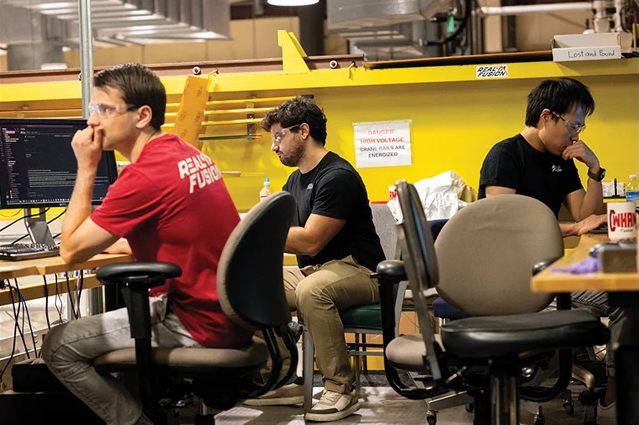
Neighboring SHINE Technologies, a well-established entity with $800 million in funding declared to date, is forging its own way toward limitless fusion energy, exploring commercial applications of the technology and — in CEO Piefer’s words — “slowly replacing fission with fusion.”
Nuclear fission splits atomic nuclei to release energy, a riskier process than fusion due to the large amounts of radioactive waste it produces. Fusion is considered safer and cleaner.
“Our fusion story is really unique,” said Tammy Kramer, SHINE’s vice president of marketing and communications. “Most of our competitors in the fusion space are spending all of their time and resources in getting to that moonshot of fusion energy on the grid — which is amazing. It’s awesome.
“But we’re taking a different approach. Getting to fusion energy is hard. It’s a hard engineering problem, it’s a hard scientific problem. But we can get to fusion energy by entering these other markets using fusion technology.”
While SHINE has historically focused on neutron testing — a radiation effects testing service that uses neutrons, the byproducts of a nuclear reaction — Piefer founded the startup with an eye on medical isotopes. It’s a market in which SHINE is now expanding.
Medical isotopes help with diagnosis and treatment for heart disease, cancer and more. SHINE sells them to hospitals, radiopharmacies, drug developers and CDMOs (contract development and manufacturing organizations) for patient use and to universities for research.
The fission reactors typically used to produce medical isotopes “are quite expensive and take long to build well,” said Piefer, and there are a limited number worldwide — housed in Europe, South Africa and Australia. Those that do exist are aging facilities that hamper the supply chain when they break down.
“There’s an access problem (to medical isotopes) fundamentally,” Piefer said. “So cost-reduction is the business reason, and that’s why we’re involved in it, frankly. But from a human perspective, these isotopes are made in 60-year old machines. … The medical isotope supply chain depends on them, and they’re getting less and less reliable over time. … Patients need this stuff.”
Last June, SHINE launched production of the medical isotope Ilumira at its Cassiopeia facility. Also known as Lutetium-177, Ilumira aids precision cancer treatment.
Just weeks later, the company announced that it was awarded $32 million from the DOE’s National Nuclear Security Administration to help build a new production facility nearby.
While the company is not yet using fusion to make its medical isotopes at Cassiopeia,it will at newcomer Chrysalis.
Chrysalis aims to rectify the supply chain problem and produce another medical isotope — Molybdenum-99 — which is the most-used diagnostic isotope in the world.
“Fusion will come into play when this building is done,” said Piefer. “As we bring Chrysalis online, our cost point for producing an isotope drops. … We can produce isotopes more flexibly and at a better cost point, and then we can use that profit to reinvest in the business.”
SHINE plans to begin commercial production of Mo-99 in early 2027, and in the meantime, the company is exploring opportunities on another frontier: nuclear waste recycling.

To wait is too late
Even as research, private investment and local innovations drive fusion advancements, experts maintain there is a vast amount of work to be done for the state to capitalize on this burgeoning industry.
As SHINE’s Kramer puts it, “Eyes are on this little hub.”
“Fusion energy represents one of the most transformative opportunities of our lifetime,” said UW-Madison’s Diem in a statement. “Not only to deliver clean, reliable power, but to drive innovation and economic growth here in Wisconsin.”
According to 5 Lakes’ Gallagher, that can be accomplished only if Wisconsin — and the Great Lakes region — build an ecosystem for the industry now.
“It’s not obvious,” she said. “A lot of people would say, ‘Let’s wait and see what happens,’ but if you wait and see what happens, are you setting the groundwork? … We had a foothold in genetics, and we didn’t build an ecosystem around it. I think you could argue, in some ways, that we left the university to do it, and that’s not what they do. They do research, and they can spin out companies. They don’t build ecosystems.
“You need the state to make it a priority. … You need to keep these fusion companies here. You need to be attracting other fusion companies. … You need to have a strategy for, in our case, building the supply chain. You need to build everything else around it.
“I don’t think Wisconsin can do it alone. It takes five Great Lakes states to equal the population of California. We need to do it as a regional play.”
The Great Lakes Fusion Energy Alliance — which includes Realta, SHINE, Strohwig Industries in Richfield and Grand Rapids, Michigan-based Paragon D&E, among others — is set to do just that, bringing together the region’s engineering and manufacturing assets to set the stage for fusion.
At the state level, Gov. Tony Evers this summer signed two bipartisan bills designed to strengthen nuclear power in Wisconsin — one that called for a $2 million study to find the best location in the state for a nuclear fusion plant, and another establishing a Nuclear Power Summit Board to advance technology and host a national summit in Madison in 2028.
In a July 2 press release, Evers stated that the bills would “propel us into an innovative, clean energy future and bring more clean jobs to our state.”
“We recently met with Gov. Tony Evers and his team,” said Realta’s Furlong. “The governor is very supportive of what we are doing, and his team (is) working hard to ensure Wisconsin is a competitive location for fusion companies. We see strong bipartisan support in the state Legislature for fusion energy and the possibilities it holds for Wisconsin.”
Attracting industry talent is another priority.
“The personnel is critical,” said Furlong, noting that Realta has made significant progress on this front, with 60% of its employees coming from out of state to work in Madison. “There’s still a challenge, but I think again this is an area where we can leverage the alumni networks, for example, of the universities in the state.
“We should be reaching out … because talent is one of the limiting factors that we have to overcome.”
When it comes to preparing the future fusion workforce, however, Realta and SHINE agree the bulk of jobs created will not be for scientists in nuclear-related disciplines.
“Most of it’s going to be regular engineers and technicians,” said SHINE’s Piefer. “Teaching them how to build fusion reactors, versus flooding the industry with huge amounts of Ph.D.s.”
“We have way more electrical and mechanical engineers than we do nuclear, and we also probably at this point have way more folks that came out of technical colleges in the area than came out of nuclear programs or even four-year degrees,” said Ross Radel, SHINE’s chief technology officer.
SHINE has lately worked to expand its relationship with area technical colleges, like Madison College, to grow what the company sees as the workforce of the future.
“There’s a small number of really specialized-type people that are really supporting a much larger workforce that’s going to be able to do all kinds of awesome things,” Radel said.“That will involve a lot of on-the-job training. That’s what’s important to drive this industry forward.”
Furlong agreed, asserting that fusion “stands to be a massive manufacturing industry,” and that new areas of specialty manufacturing will emerge to serve it.
In a region known for its advanced manufacturing capabilities, that is welcome news.
“Old Milwaukee was known as the tool shop of the world,” Furlong said. “I think we can reclaim that title for the fusion industry.”
Featured image caption: Realta Fusion and UW-Madison work side-by-side on the Wisconsin High-field Axisymmetric Mirror (WHAM) experiment to advance nuclear fusion. Photo by: Elliot Claveau/Realta Fusion.