Next-gen nuclear safety: From fission to fusion

By: Lili Sarajian
On July 2, 2025, Wisconsin passed legislation calling for a nuclear power siting study to identify opportunities for fission and fusion energy generation in the state. The bill also aims to streamline the permitting process for small modular reactors (SMRs)—a unique technology that could change the landscape of nuclear power.
Current reactors produce anywhere between 600 and 1,000 MW of electricity. SMRs are designed to be simpler and smaller, producing less than 300 MW. The idea is that SMR components could be manufactured in higher quantities offsite and shipped to plant sites for assembly, significantly decreasing production costs and the overall cost of nuclear energy generation.
These modular designs are ideal for placement in remote locations that don’t have large grids or even on ocean platforms. The concept has existed for years, but investment in SMR technology has recently grown, especially with the rise of AI data centers that require abundant, steady power sources.
The Heat Transfer and Safety Analysis (HEATS) Laboratory at the University of Wisconsin–Madison, led by Associate Professor Juliana Pacheco Duarte, is investigating methods to further improve the performance of these SMRs.
“We believe SMR technology holds great promise as an energy solution,” says Duarte, “and we are advancing methodologies to enhance both its safety and efficiency.”
One method of improving safety and efficiency is utilizing accident tolerant fuels (ATFs) in SMRs. The HEATS lab is studying ATFs backed by funding from the U.S. Department of Energy (DOE) through the Nuclear Energy University Program (NEUP). ATFs are more resistant to radiation, corrosion, and high temperatures, so they perform better in the extreme environment of a nuclear reactor and could provide wider safety margins in an accident scenario.
However, metallic ATFs also have some material properties that could induce accidents. Metallic nuclear fuels produce hydrogen gas when they oxidize, as well as oxidation heat, both of which can increase the likelihood of a severe accident.
Undergraduate student Priscilla Lee is studying the oxidation of these ATFs to build a model that can predict how different factors lead to reactor meltdowns. The project is led by Dr. Mohammad Amer Allaf, a Postdoctoral Research Associate in the Department of Nuclear Engineering and Engineering Physics.
Lee uses an accident analysis code called MELCOR, a system code developed by Sandia National Laboratory (SNL), to simulate accident progression in fission reactors. She adapted the program to calculate fuel oxidation and determine how metallic fuels cause hydrogen and heat buildup.
“The better of an accident scenario we can model, the more we can safeguard against it, and the more we can make our reactors accident resistant,” says Lee. “We want to characterize as many factors that can lead to a core meltdown as possible.”
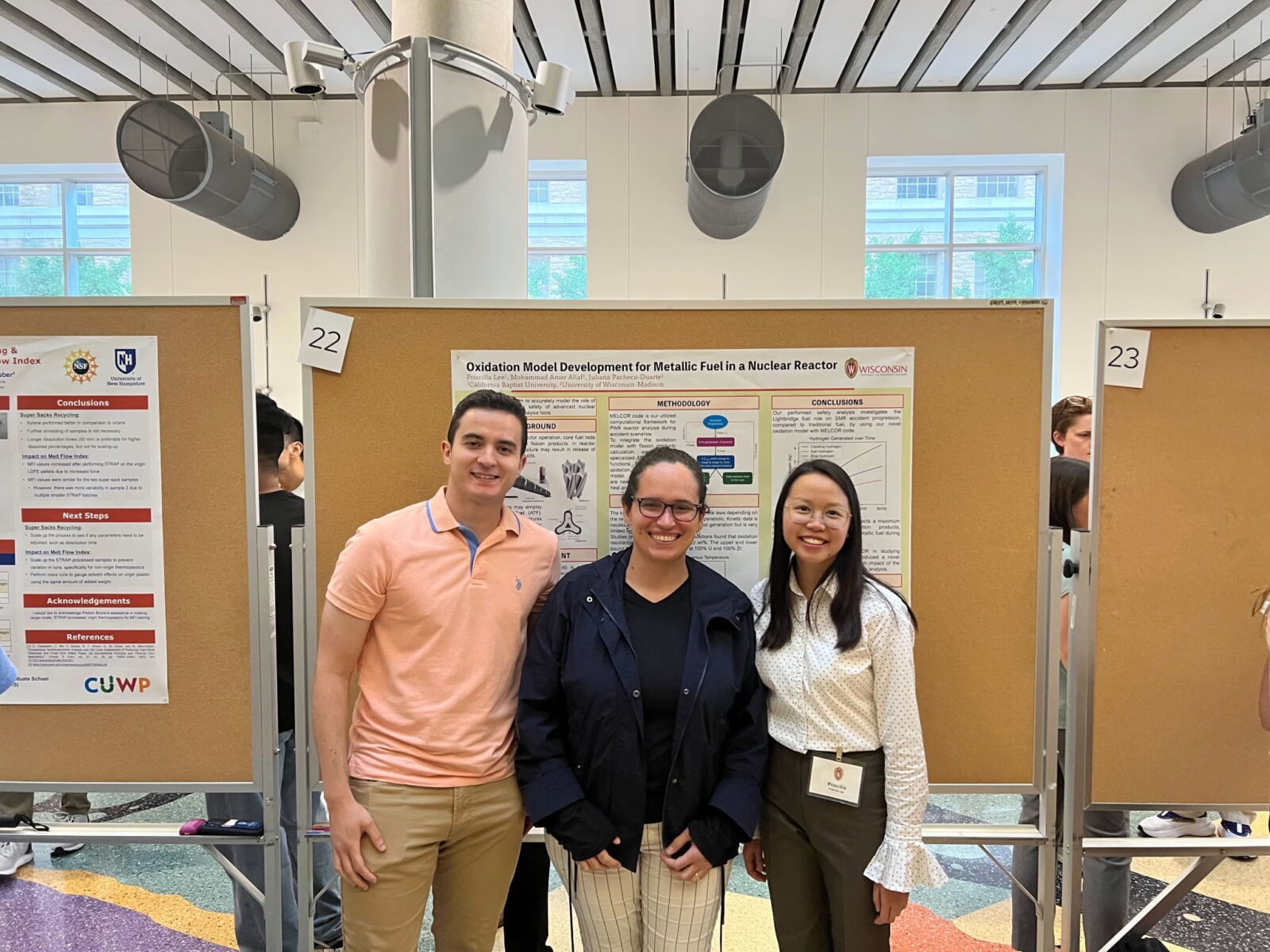
Lee joined the HEATS Lab over the summer through the College of Engineering Summer Undergraduate Research in Engineering (SURE) program. The Department of Nuclear Engineering and Engineering Physics received a $100,000 grant from NEUP to establish this program and support undergraduate students interested in nuclear engineering research.
While Lee is majoring in chemical engineering, she became interested in nuclear engineering through exposure to the energy industry and alternative fuels.
“Nuclear is a lot more robust than some of the other alternative fuel options,” says Lee, “but politically, there is opposition, so I really wanted to learn more about the misconceptions.”
With hundreds of licensed nuclear power plants in operation, a growing percentage of the world’s electricity is safely generated by nuclear energy. The research initiatives within the HEATS Lab are only continuing to improve the accident resistance of current and future reactors.
Another core area of study within the HEATS Lab is critical heat flux (CHF), or the point at which heat transfer decreases and the surface temperature spikes. If heat flux reaches that critical point, the outer layer of the fuel rods—or cladding—could rupture and release radioactive material.
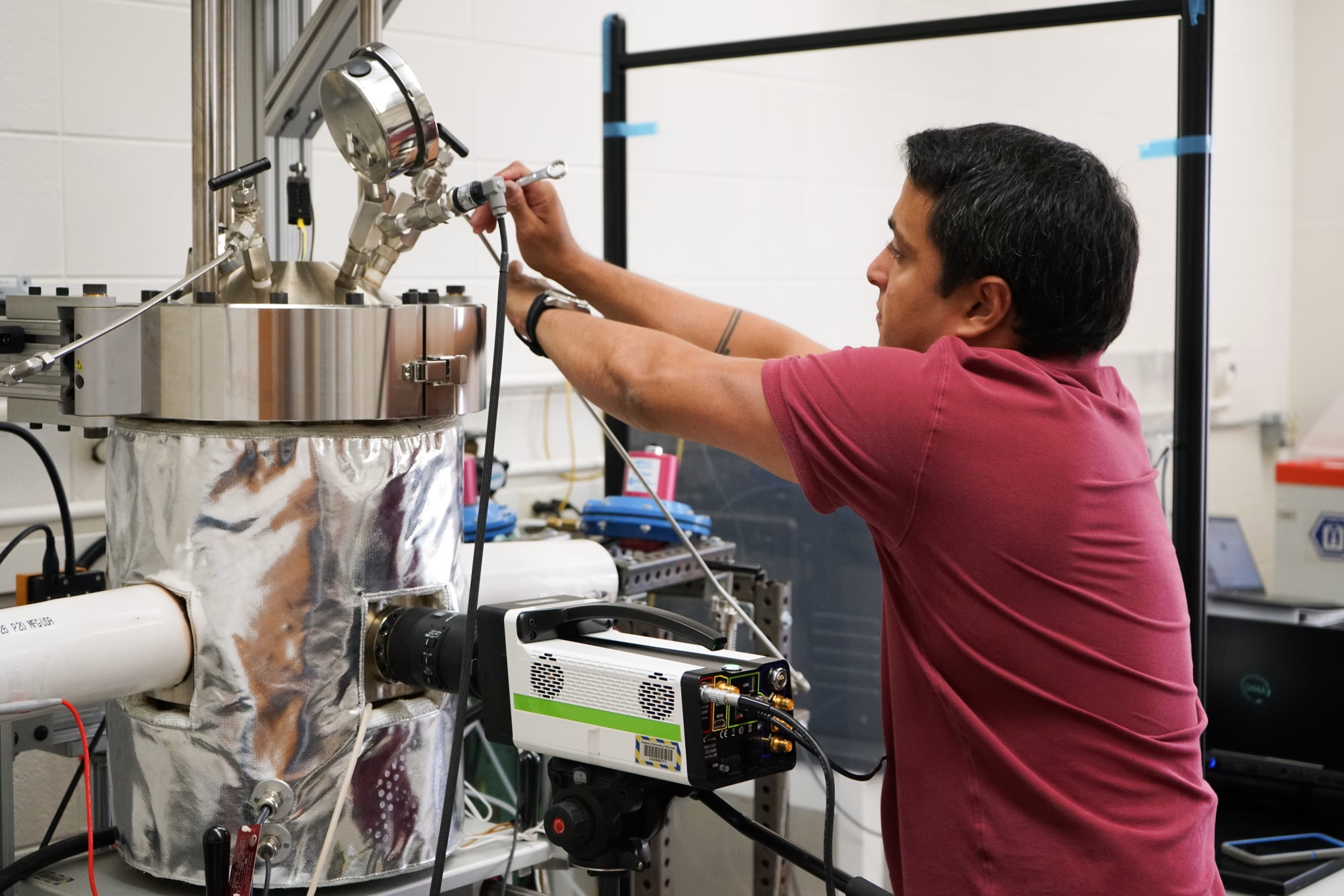
To analyze CHF, PhD student Bruno Serrao applies machine learning models to predict the maximum boiling point at which CHF occurs. He also designed a custom pool boiling experiment that allows him to monitor the boiling process using a high speed camera.
“At some point, the surface gets so hot that you see a vapor film over it, and you know heat transfer is deteriorating because water transfers heat better than vapor,” says Serrao. “That’s the point we are trying to avoid.”
Featured image caption: PhD student Bruno Serrao sets up his custom pool boiling experiment to monitor how material surface characteristics impact heat transfer.