InsideWis: Much at stake for Wisconsin in fast-moving fusion, fission worlds

By: Tom Still
Originally posted in Wisconsin Technology Council.
Progress toward unleashing clean power from nuclear fusion was recently reported by Chinese scientists, who broke through a theoretical ceiling on how many atoms can “fuse” inside a superconducting reactor and efficiently release energy.
If confirmed, it’s a big step toward creating “artificial suns” on Earth that would revolutionize how electricity is generated. It also showed why the United States, with help from companies, researchers and public officials in states such as Wisconsin, must keep pace in worldwide races to advance fusion as well as nuclear fission.
Two definitions will help explain why that’s important:
- Fusion is the same atomic reaction that powers the sun. It’s an emissions-free form of energy generation that works by melding lightweight atoms (deuterium and tritium) to produce sub-atomic particle neutrons, helium and energy. The most stubborn issue for the world’s scientists has been how to do so at scale.
- Fission occurs when the nucleus of an atom splits into two or more smaller nuclei and other particles, producing energy through a controlled process. Nuclear power plants have generated power this way since the 1950s but are undergoing a technological rebirth that could improve safety and economic payback while regaining public favor.
Why am I putting you to sleep with this over-simplified science lesson? To better explain why Wisconsin has a stake in both races.
When it comes to advancing fusion energy, Wisconsin has several advantages. First, there are a small handful of state-based fusion companies. Second, the UW-Madison’s College of Engineering is renowned for its engineering physics department, a source of fusion talent and research. Third, state officials have warmed to the idea of opening regulatory and other pathways to help make Wisconsin a fusion hub.
There’s still a long way to go, especially when it comes to the mega-dollars needed to bring fusion companies to the goal line. Tech Crunch, which reports on technology news, recently listed 13 private fusion firms that have collectively raised billions of private equity dollars. Only one Wisconsin firm, SHINE Technologies in Rock County, made the list. But one Wisconsin company is better than none.
Fusion competition comes from Europe, East Asia and China, which is opting for state-run investment versus private dollars. Either way, no world power will wait for the United States to catch up.
Nuclear fission is a similar story. Many Americans are still hung up over the 1979 nuclear accident at the Three Miles Island power plant in Pennsylvania, even though no one died and long-term studies show negligible health effects. Modern designs should alter that outdated public perception.
Japan has done so inside a generation. It has restarted the world’s largest nuclear power plant about 135 miles from Tokyo, which was shut down by a 2011 earthquake and tsunami. In fact, 14 fission power plants have reopened in Japan with modern reactor designs.
China is fast becoming the world’s leader in fission power and will likely eclipse the United States by 2030. Since 2013, China has built 13 reactors with another 33 underway, the New York Times has reported. China’s power plants have mostly American or French designs, which suggests it has found ways to overcome construction and cost overruns that hamper U.S. progress. Red tape is a U.S. speed bump; China can open a new plant in five to six years.
It’s not that other countries have turned against solar or wind power. Rather, it’s a recognition that a balanced approach to generation and transmission is needed.
Here’s a fact for your next trivia contest: 15.5% of all electric power generated in Wisconsin comes from two fission plants, Point Beach Units 1 and 2 near the shore of Lake Michigan. That’s more than all of the state’s solar, wind, hydro and biomass sources combined. Coal has dropped from 60% to 32% since 2010, so a mix of generation sources must fill the gap.
Nuclear power in both forms, fission and fusion, is capturing international attention. At a time when many Americans worry about global climate change, they should also get over time-worn biases about nuclear power.
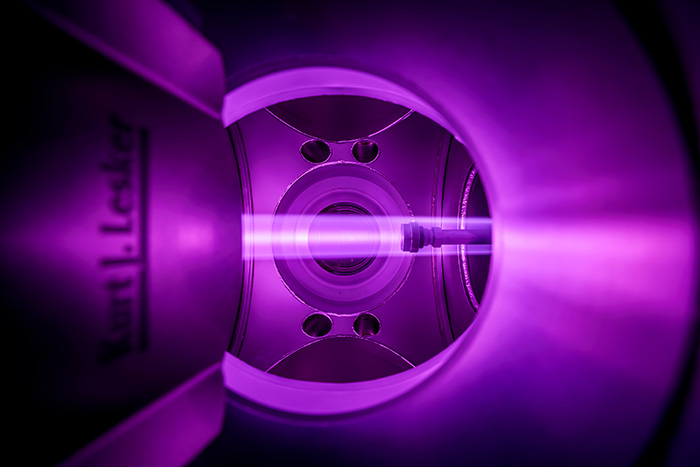
Featured image caption: The PISCES facility generates and studies how plasmas found in fusion energy systems interact with the material walls of plasma confinement devices. Photo by: David Baillot/UC San Diego Jacobs School of Engineering.